What counts
- Photography: the world we work in. The rules are below.
- The layer: the fine line drawing over all our photography, so the set reads as ours.
- Diagrams: our own drawings of how things work, kept in Galleries.
- People: faces with the mark have their own rules, under Brand, People.
Photography
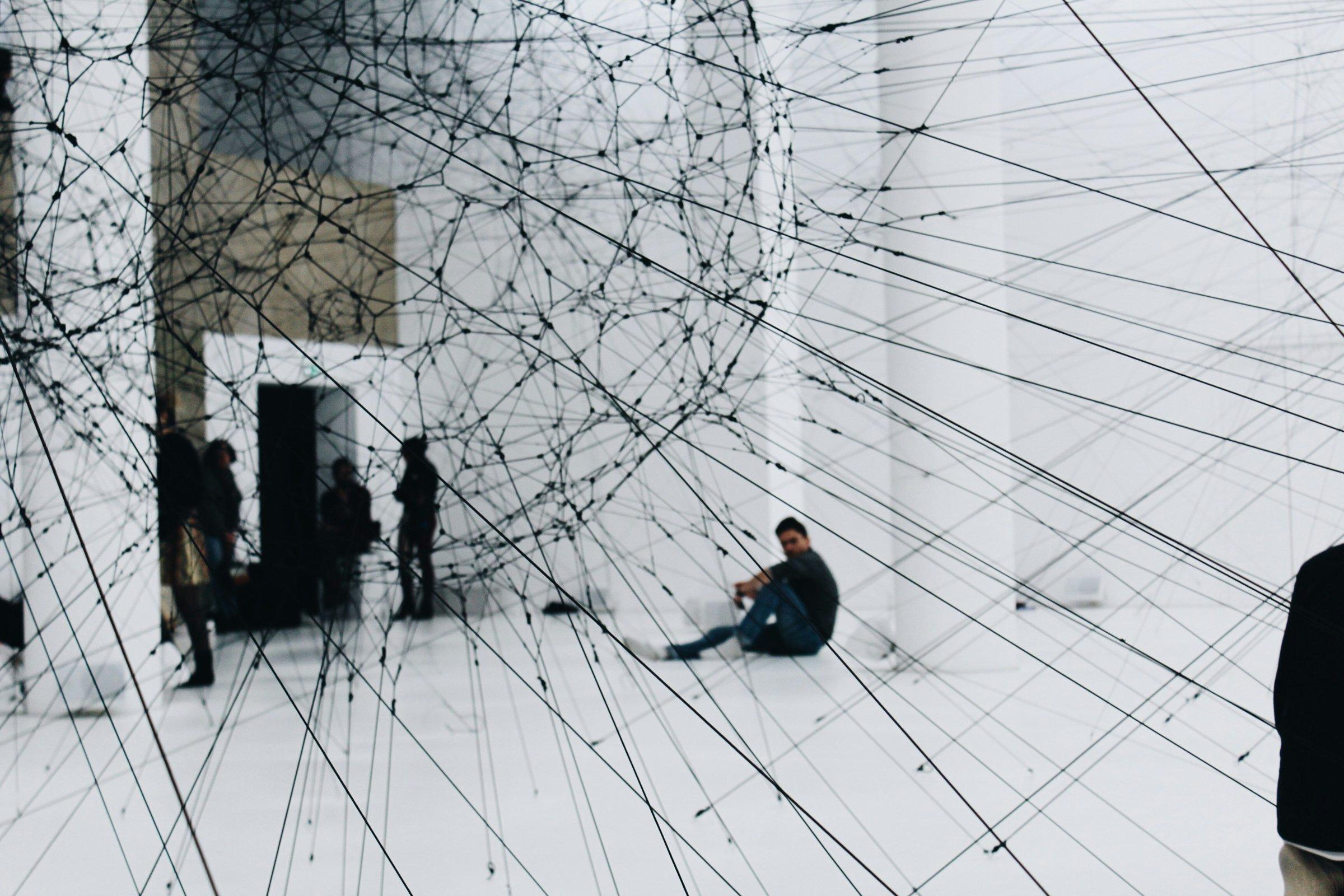
All our photography comes from the same collection, and all of it is shown the same way: a light tint so the set reads as one, and a fine line drawing over the top. Below, one picked at random from the collection on each visit.
Choosing
The photograph does not need to look like a diagram. The layer brings the structure. The photograph needs to feel like the world we work in: the messy middle, where people bump into technology.
- Natural or made. Landscapes, buildings, objects, and workplaces are all welcome.
- No words in the picture. No signs, lettering, screens with text, or graffiti.
- No faces as the subject. People at a distance, from behind, or as hands at work are fine.
- A quiet area for words. Usually the lower third, where the fade sits.
- A consistent tone. Natural light and muted colour, nothing glossy. The tint pulls the set together, but it cannot rescue a loud photo.
Avoid the stock clichés: handshakes, lightbulbs, chess pieces, people pointing at screens, robots, binary code, and globes of connected dots. If a photo needs a caption to make sense, it is the wrong photo.
The Layer
A collection of fine line drawings: flowcharts, grids, and figures in two and three dimensions, from a tesseract to a sphere to a Rubik's cube. Refined and quiet, they say whose thinking this is without a name on it. There is no logo and no slash on our photography.
- Drawn in code, never baked in. The photograph stays clean; change a layer once and every photograph changes.
- Hairlines in white, the same fineness at every size.
- Off-centre, running off the edges. Caught in passing, never framed like a badge.
- Clear of the words. The layer fades out towards the foot of the frame.
- One layer per photo. A photo can name its layer; if it does not, one is chosen for it.
The first layer is the flowchart. More will follow, and they may change from time to time.
Pointing
Point at any of our photography and the layer fades away, showing the picture as the photographer made it, and the credit appears in the top corner. It is a fade, never a movement. Touch screens cannot point, so there the layer stays and the credit is always shown, small.
Keeping
- All our photography lives in our own library, with a record for each picture: photographer, links, size, and where it is used.
- Three sizes: the full-size original as the backup, a 2400px version philpin.com shows, and a small one for tables.
- Nothing is pulled live from Unsplash. We download once and serve our own copy.
Crediting
The credit reads Photograph: Name / Unsplash, in the Credit style. It links to the picture's row in the Photography gallery, which links on to the photographer and the original. The gallery is the credit of record: all the photography on the site is listed there.